
 DEMOGOD
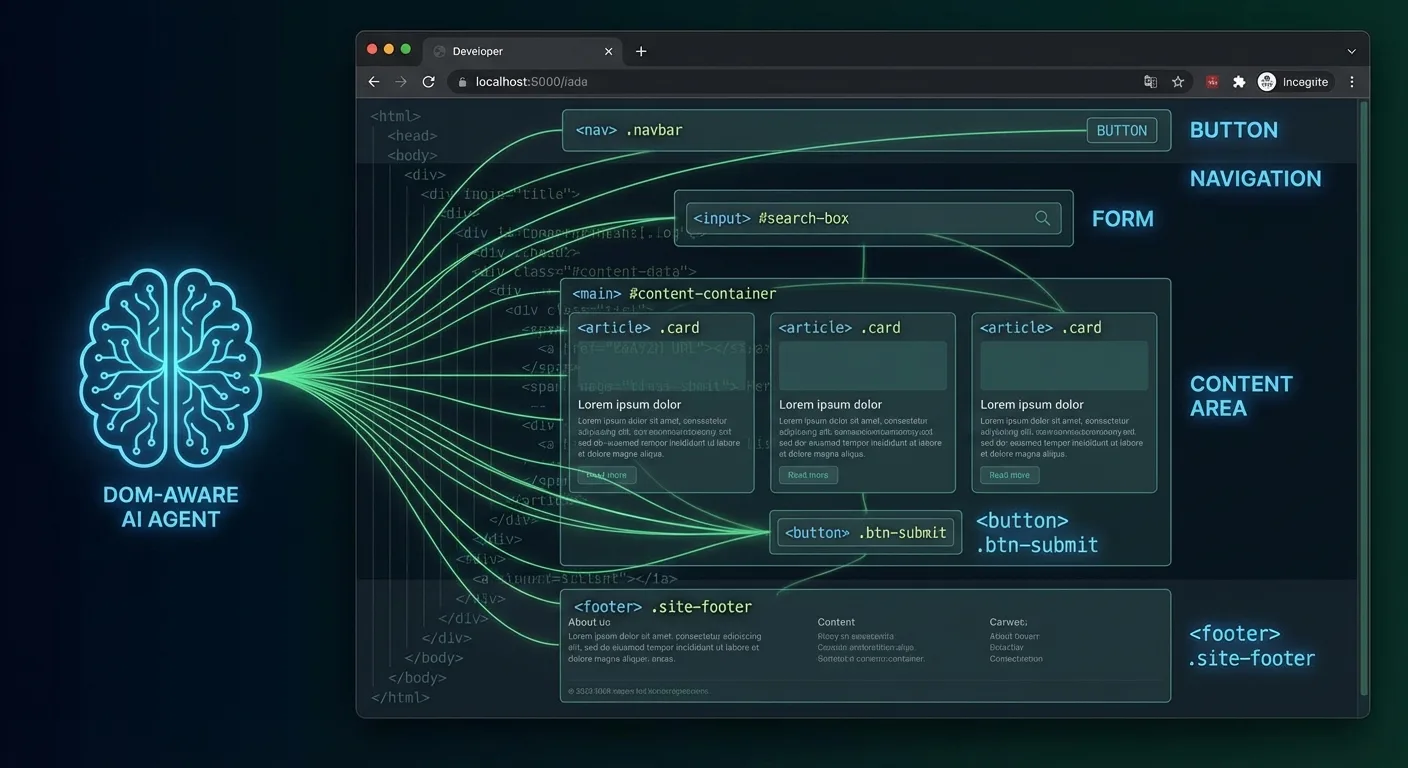
Beyond Simple Chatbots: AI That Actually Sees Your Website
Most AI assistants are blind. They can answer questions about your product, but they have no idea what's actually on the screen. Ask them "where do I click to sign up?" and they'll give you generic instructions that may or may not match your actual interface.
DOM-aware AI changes everything.
These intelligent agents don't just talk—they see. They understand the structure of your webpage in real-time, can locate specific buttons and forms, and guide users with precision: "Click the green 'Get Started' button in the top right corner of your screen."
What is the DOM, and Why Does It Matter?
The Document Object Model (DOM) is the structured representation of every webpage. Think of it as the blueprint that browsers use to render what you see on screen:
- Every button, link, and image is a node in this tree structure
- Each element has properties—its text, color, position, and state
- The DOM updates dynamically as users interact with the page
When AI can read and interpret the DOM, it gains something revolutionary: spatial awareness of your digital environment.
How DOM-Aware Voice AI Works
The technology involves several sophisticated layers working together:
1. Real-Time DOM Parsing
The AI agent continuously scans the webpage structure, building an internal map of:
- Interactive elements (buttons, links, form fields)
- Content hierarchy (headings, paragraphs, lists)
- Visual layout (element positions, visibility states)
- Dynamic changes (new content loaded, modals opened)
2. Semantic Understanding
Raw DOM data is meaningless without interpretation. The AI applies natural language understanding to recognize:
- What each element does ("this is a checkout button")
- What information it contains ("this shows the product price")
- How elements relate to each other ("this form submits to that endpoint")
3. Context-Aware Guidance
When a user asks for help, the AI combines their request with its DOM understanding to provide precise, actionable guidance:
User: "How do I change my shipping address?"
DOM-Aware AI: "I can see you're on the checkout page. Click 'Edit' next to the shipping section—it's the blue link below your current address. Would you like me to wait while you make changes?"
Real-World Applications
DOM-aware AI transforms user experience across industries:
E-Commerce Product Discovery
Voice agents guide shoppers through complex product catalogs:
- "Show me laptops under $1000" → AI filters results and describes what's now visible
- "Compare these two" → AI reads specifications from both product cards
- "Add the second one to my cart" → AI locates and can highlight the specific button
SaaS Onboarding
New users navigate complex software interfaces with voice guidance:
- "How do I create my first project?" → Step-by-step navigation through the actual UI
- "Where are my settings?" → Direct pointer to the settings menu location
- "This dashboard is confusing" → Contextual explanation of each visible element
Accessibility Enhancement
DOM-aware AI becomes a powerful accessibility tool:
- Screen reader users get conversational navigation instead of linear DOM traversal
- Motor-impaired users receive precise voice commands for any action
- Cognitive accessibility improves with plain-language explanations of complex interfaces
Form Filling Assistance
Complex forms become manageable conversations:
- AI identifies required fields and guides users through each one
- Validation errors are explained in context: "The email field shows an error—it looks like you're missing the @ symbol"
- Multi-step forms are navigated with awareness of progress and remaining steps
Technical Architecture
Building DOM-aware voice AI requires integrating several technologies:
Browser Integration
A lightweight JavaScript agent runs in the browser, providing:
- DOM observation via MutationObserver API
- Element location and visibility detection
- Event interception for user action tracking
- Secure communication with AI backend
Voice Pipeline
Real-time voice interaction powered by:
- WebRTC for low-latency audio streaming
- Speech-to-text for understanding user requests
- LLM processing for intent recognition and response generation
- Text-to-speech for natural voice output
DOM Intelligence Layer
The bridge between raw DOM data and actionable AI understanding:
- Element classification and importance scoring
- Spatial relationship mapping
- Action possibility detection (what can be clicked, typed, selected)
- State change monitoring
Implementation Considerations
Deploying DOM-aware AI requires attention to several factors:
Performance
DOM parsing must be efficient to avoid impacting page performance:
- Selective observation (only track relevant elements)
- Throttled updates (batch rapid changes)
- Lazy evaluation (analyze on-demand, not continuously)
Privacy
DOM access means access to page content—handle responsibly:
- Never transmit sensitive form data (passwords, payment info)
- Anonymize or exclude personal information from analysis
- Provide clear user disclosure of AI capabilities
Dynamic Content
Modern SPAs constantly modify the DOM:
- Handle React/Vue/Angular virtual DOM patterns
- Detect and adapt to lazy-loaded content
- Maintain context through navigation events
The Competitive Advantage
Websites with DOM-aware voice AI offer fundamentally better experiences:
- Reduced friction—users never get lost or confused
- Faster task completion—voice guidance beats hunting through menus
- Higher accessibility—inclusive design without redesigning interfaces
- Differentiation—most competitors still offer static pages or blind chatbots
Getting Started
Implementing DOM-aware AI doesn't require rebuilding your website. Solutions like Demogod provide drop-in integration:
- Add a single script tag to your pages
- Configure which areas the AI should understand
- Customize the voice and personality
- Launch with full DOM awareness from day one
The AI handles the complex DOM parsing, voice processing, and natural language understanding—you just provide the website.
The Future of Web Interaction
DOM-aware AI represents a fundamental shift in how users interact with websites. Instead of learning your interface, users simply talk to it. Instead of hunting for buttons, they ask and receive precise guidance.
The websites that adopt this technology early will define the next generation of user experience. The rest will feel increasingly archaic—like websites without search, or apps without mobile support.
Your users are ready to talk to your website. The question is: can your website see them back?
Experience DOM-aware voice AI in action. Try Demogod's interactive demo and see how AI can truly understand and navigate your web interface.