 DEMOGOD
The Disconnect Between Features and Success
Most demo tools excel at showing your product's features.
They break down the moment a real user tries to navigate independently, gets stuck on an edge case, or asks "what should I do next?" That's when you realize: connectivity isn't the same as guidance.
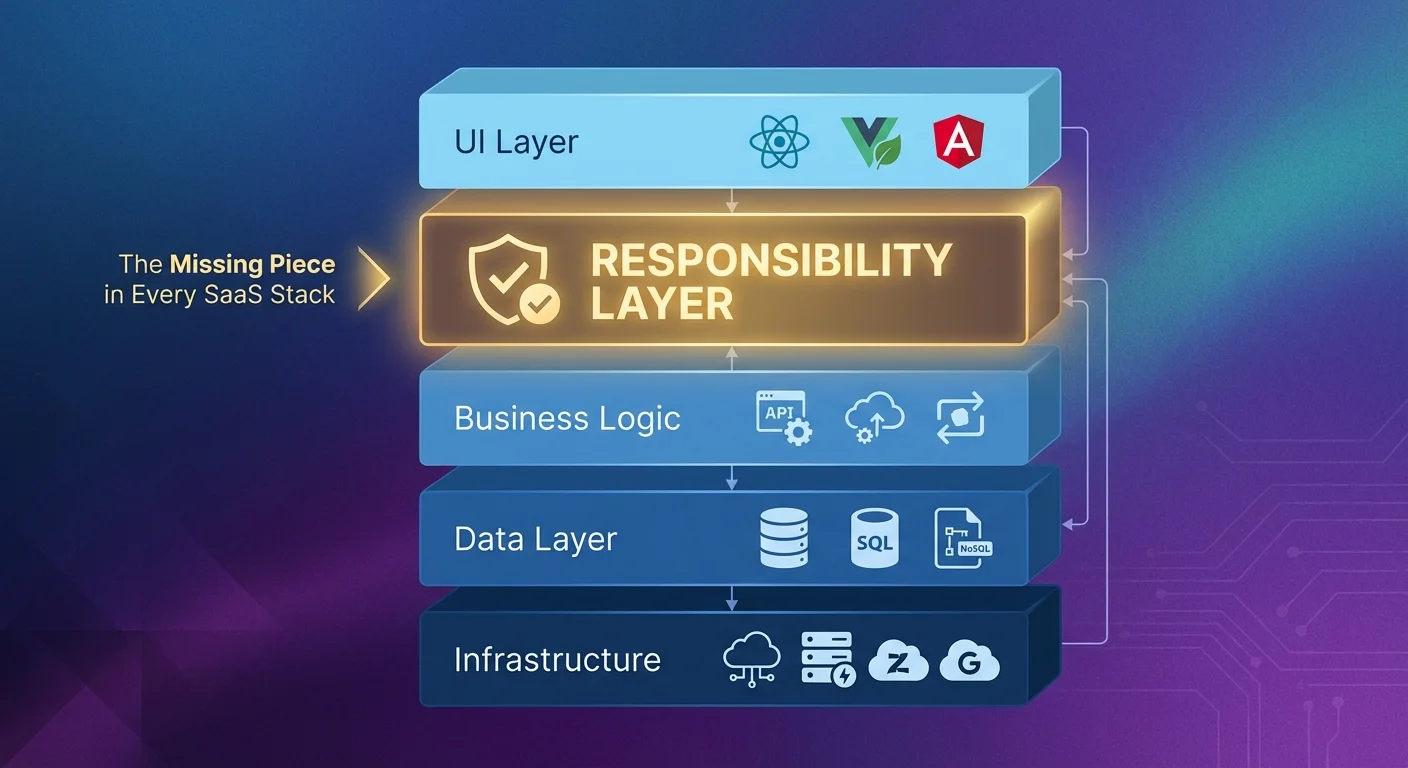
A viral thread on Indie Hackers this week nailed a fundamental problem that extends far beyond automation tools: "Automation tools connect things. They don't take responsibility."
When workflows fail, no one knows who's responsible. The same problem exists in product demos.
Connectivity vs. Responsibility in Product Demos
Traditional product demos are built on a connectivity model:
- Tooltips pointing to features
- Pre-recorded videos showing workflows
- Click-through tours with fixed paths
- Documentation that users must find themselves
These tools connect users to features. But here's the problem: users still get lost. Industry average bounce rate for product demos sits at 70%.
Why? Because connecting features doesn't mean owning outcomes.
When a user gets confused halfway through your demo, who guides them back? When they encounter an edge case your tour didn't anticipate, who adapts the experience? When they ask "what should I do next?"—who answers?
No one. Because traditional demos connect, but they don't take responsibility.
The Responsibility Model: What Ownership Looks Like
Voice AI changes this equation entirely. At Demogod, we built demo agents that don't just connect features—they own the user journey.
Here's what responsibility looks like in practice:
- Listen: AI detects when users hesitate or ask questions
- Guide: Real-time adaptation to the user's path
- Adapt: Handles edge cases without pre-programming every scenario
- Verify: "Did that work for you?" checks for success
- Improve: Conversation logs reveal exactly where users struggle
The result? Bounce rates drop from 70% to 30-40%. Not because the product changed, but because someone—or something—takes responsibility for user success.
Why "Connecting" Isn't Enough
From that viral Indie Hackers thread:
"Connecting things feels productive, but outcomes matter more than flows. Without clear ownership, automation just moves complexity around instead of removing it."
Apply this to product demos:
- Adding more tooltips = connecting features
- Recording more tutorial videos = connecting workflows
- But who owns the outcome when users still bounce?
This is the silent failure of traditional demos:
- Analytics show 70% bounce rate
- No one knows why (users don't leave feedback)
- Dashboard reports "workflow complete" but users felt lost
- No accountability = no improvement
You can't fix what you can't see. And connectivity-based demos hide failure behind metrics.
What This Means for SaaS Founders
The traditional approach follows a predictable cycle:
- Build feature
- Add tooltip
- Hope users find it
- If they don't: "we need better docs"
- Repeat
This is a connectivity mindset. You're solving for access, not outcomes.
The responsibility approach looks different:
- Build feature
- AI agent owns introducing it
- If users struggle: AI adapts guidance in real-time
- Conversation logs show exactly what confused users
- Improvement is data-driven, not guesswork
The mindset shift is simple but profound:
Stop asking: "How do I connect users to features?"
Start asking: "Who takes responsibility when users get lost?"
The Future of Product Onboarding
That same Indie Hackers thread offered another insight:
"Workflows should graduate into products instead of collapsing under complexity."
Apply this to demos: Demos should graduate into guided experiences instead of collapsing into bounce rates.
The evolution is clear:
- Phase 1: Static demos (videos, docs) → users feel abandoned
- Phase 2: Interactive demos (tooltips, tours) → users feel guided but constrained
- Phase 3: Voice AI demos (conversational guidance) → users feel supported
Phase 3 isn't about adding more features to your demo. It's about adding ownership.
The Five-Word Competitive Moat
They connect. We take responsibility.
That's the entire difference between traditional demo tools and what we're building at Demogod. It's not a feature difference—it's a category difference.
Traditional tools are built on the assumption that if you show users where things are, they'll figure out the rest. Voice AI is built on the assumption that guidance is continuous, adaptive, and accountable.
When users can access your features but still leave confused, you don't have a connectivity problem. You have a responsibility problem.
What Ownership Changes
When you move from connectivity to responsibility, three things change:
1. Users don't fail silently.
They ask questions. They express confusion. And the system responds in real-time instead of redirecting them to docs.
2. Product teams get actionable feedback.
Conversation transcripts reveal exactly where users struggle. Not "70% bounced at Step 3"—but why they bounced.
3. Demos become part of the product, not documentation.
Voice-guided demos don't sit outside your product experience—they're integrated into it. The AI that guides new users can guide existing users through new features.
Try It Yourself
The next time you analyze your demo bounce rate, ask yourself:
"Do I have a connectivity problem or a responsibility problem?"
If users can access your features but still leave confused, you don't need more tooltips. You don't need another tutorial video. You don't need better docs.
You need someone—or something—to take ownership of their success.
That's what Demogod does.
We don't just connect users to features. We take responsibility for whether they succeed.
Want to see responsibility-based demos in action? Try our live demo at demogod.me/demo. The AI agent will guide you through—and take ownership of your experience.