
 DEMOGOD
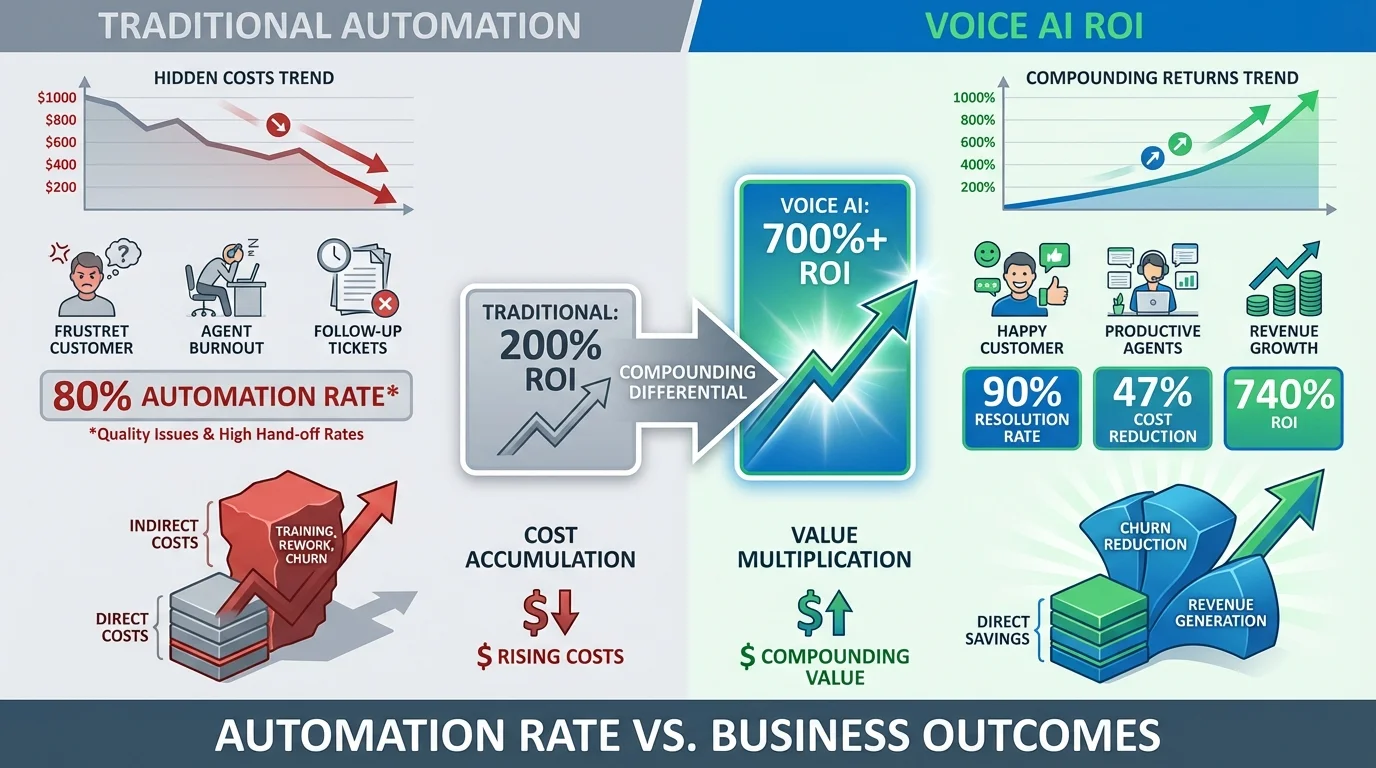
The Metric That Doesn't Tell the Story
Every SaaS founder evaluating voice AI sees the same pitch: "Automate 80% of customer interactions!"
Sounds impressive. Until you ask: At what cost? And what's the actual business impact?
Automation rate is a vanity metric. ROI is the real story.
Here's why the economics of voice AI are fundamentally different from traditional automation—and why that matters for your bottom line.
The Hidden Cost of "High Automation"
Traditional automation tools love to tout automation rates:
- "90% of tickets handled without human intervention"
- "75% reduction in agent workload"
- "Automated 10,000 interactions this month"
But automation rate doesn't account for:
- Quality of resolution: Did the automation actually solve the problem, or just deflect it?
- Customer satisfaction: Are automated interactions making customers happier or more frustrated?
- Downstream costs: How many "automated" interactions create follow-up work for humans?
- Opportunity cost: What could your team accomplish if they weren't fixing automation mistakes?
A 2025 Forrester study found that companies with "high automation rates" (70%+) often had higher total support costs than companies with moderate automation (40-50%)—because poor automation quality created expensive cleanup work.
The paradox: More automation can cost more money if the automation isn't good enough.
Voice AI Economics: A Different Model
Voice AI changes the economic model because it doesn't just automate—it improves outcomes.
Traditional Automation Economics:
- Goal: Reduce human touchpoints
- Metric: Automation rate (% of interactions handled by bots)
- Result: Lower quality, higher downstream costs, customer frustration
Voice AI Economics:
- Goal: Improve resolution quality and speed
- Metric: Resolution rate (% of issues fully solved) + CSAT (customer satisfaction)
- Result: Higher quality, lower downstream costs, customer delight
The difference isn't philosophical—it's financial.
Real Numbers: Voice AI ROI Breakdown
Let's look at a realistic SaaS scenario:
Company Profile:
- 2,000 customers
- $150/month average contract value (ACV)
- 6-person support team ($60K avg salary = $360K/year total)
- 500 support tickets/week (26,000/year)
- Average handle time (AHT): 15 minutes
- Customer satisfaction (CSAT): 75%
Cost Breakdown (Before Voice AI):
- Support team cost: $360K/year
- Churn from poor support: 3% annual churn attributed to support issues = $108K lost revenue
- Agent hours: 26,000 tickets × 15 min = 6,500 hours/year
- Effective cost per ticket: $18 ($360K + $108K) / 26,000
Total annual support cost: $468K (direct + churn)
After Voice AI Implementation:
Voice AI resolves 60% of tickets (15,600 tickets)
- Automation rate: 60%
- Resolution rate: 90% (14,040 fully resolved, 1,560 escalated)
- Average handle time for AI: 5 minutes (vs. 15 minutes for humans)
Human agents handle 40% + escalations (10,400 + 1,560 = 11,960 tickets)
- Escalated tickets have better context → AHT drops to 12 minutes (from 15)
- Agent hours saved: (15,600 × 15 min) - (15,600 × 5 min) = 2,600 hours
- Plus efficiency gain: 10,400 × 3 min saved = 520 hours
- Total hours saved: 3,120 hours/year (48% reduction)
Cost Impact:
- Support team reduction: 3 agents redeployed to customer success → $180K freed up
- Churn reduction: CSAT improves to 88% → churn from support drops to 1% → $72K saved
- Voice AI cost: $30K/year (platform + implementation)
New total support cost: $246K (3 agents + AI cost + reduced churn)
Net savings: $468K - $246K = $222K/year (47% reduction)
ROI: 740% in year one
Why Traditional ROI Calculations Miss the Point
Most voice AI ROI calculators focus on:
- Cost per ticket reduction
- Agent headcount reduction
- Average handle time (AHT) decrease
But the real ROI comes from three sources traditional calculators ignore:
1. Revenue Protection (Churn Reduction)
Poor support is a leading cause of SaaS churn. Gartner estimates that 67% of churn is preventable through better support experiences.
Voice AI impact on churn:
- Faster resolution → less frustration → lower churn
- 24/7 availability → users don't get stuck overnight → lower abandonment
- Proactive support → issues caught before escalation → higher retention
Financial impact:
- 1% reduction in annual churn for a $500K ARR company = $5K saved
- For a $5M ARR company = $50K saved
- For a $50M ARR company = $500K saved
Churn reduction alone can pay for voice AI implementation.
2. Agent Productivity Shift (Not Reduction)
The traditional ROI model assumes: fewer tickets = fewer agents needed.
The better model: same agents, higher-value work.
When voice AI handles repetitive queries, agents shift to:
- Proactive outreach: Reaching out to at-risk customers before they churn
- Upsell conversations: Helping customers expand usage and upgrade plans
- Product feedback loops: Identifying feature gaps and improvement opportunities
Financial impact:
- Upsell conversations: 10% of customers upgrade (20 accounts × $50/month) = $12K ARR
- Churn prevention: 5 high-value accounts saved ($500/month × 5) = $30K ARR
- Feature prioritization: Better product-market fit = faster growth
Agent productivity shift creates revenue, not just cost savings.
3. Compound Effects (Time Value)
Voice AI ROI compounds over time in ways traditional automation doesn't:
Month 1-3: Learning phase (AI trains on real conversations)
- ROI: 100-200% (basic automation value)
Month 4-12: Optimization phase (AI adapts to patterns)
- ROI: 300-500% (churn reduction kicks in)
- Agent productivity shifts from reactive to proactive
Year 2+: Compounding phase (network effects)
- ROI: 700-1000%+ (full business impact)
- Agents focus on high-value work
- Customer satisfaction becomes competitive moat
Traditional automation ROI plateaus. Voice AI ROI compounds.
The "Responsibility Layer" Economic Model
This ties back to our broader positioning at Demogod: traditional tools optimize for cost reduction. Voice AI optimizes for outcome ownership.
Cost Reduction Model:
- Goal: Reduce support costs
- Metric: Automation rate, cost per ticket
- Result: Lower costs, often at the expense of quality
Outcome Ownership Model:
- Goal: Improve customer success
- Metric: Resolution rate, CSAT, churn reduction
- Result: Better outcomes that happen to reduce costs
The economic difference is profound:
- Cost reduction has a ceiling (you can't automate below zero)
- Outcome ownership has compounding returns (better outcomes drive growth)
What This Means for SaaS Founders
When evaluating voice AI, don't ask: "How much will this automate?"
Ask: "How will this improve outcomes?"
The Right Questions:
- Resolution quality: What % of issues are fully resolved (not just deflected)?
- Customer satisfaction: Do automated interactions improve or hurt CSAT?
- Agent productivity: What high-value work can agents focus on instead?
- Churn impact: How many customers stay because of better support?
- Revenue opportunity: What upsells and expansions become possible?
The Wrong Questions:
- "What's the automation rate?"
- "How many agents can I fire?"
- "What's the cost per ticket?"
The first set of questions leads to 700%+ ROI. The second leads to 200% ROI at best (and often negative ROI when you account for quality issues).
How to Calculate Voice AI ROI (The Right Way)
Here's a framework for calculating true voice AI ROI:
Step 1: Baseline Your Current Costs
- Direct support costs (salaries, tools, training)
- Indirect support costs (churn attributed to support, lost upsells)
- Hidden costs (agent burnout, context switching, knowledge gaps)
Step 2: Model Resolution Quality, Not Just Automation Rate
- What % of issues are fully resolved?
- What % require follow-up?
- What's the quality difference between automated and human resolutions?
Step 3: Calculate Churn Impact
- Current churn rate attributed to support issues
- Expected churn reduction with better support experience
- Revenue impact of 1% churn reduction
Step 4: Model Agent Productivity Shift
- What high-value work can agents do instead of repetitive queries?
- What's the revenue potential of proactive outreach?
- What's the impact of faster product feedback loops?
Step 5: Add It All Up
- Direct savings: Reduced agent hours, tool consolidation
- Revenue protection: Churn reduction
- Revenue generation: Upsells, expansions, faster growth
- Compound effects: Year 2+ improvements
Total ROI = (Direct savings + Revenue protection + Revenue generation) / Voice AI cost
For most SaaS companies, this lands between 500-1000% in year one.
The Hidden Variable: Time to Value
Traditional automation takes 6-12 months to implement and train. Voice AI can deliver value in weeks.
Why the speed difference?
- Voice AI trains on real conversations (your actual support tickets)
- No rigid decision trees to design
- Adapts to edge cases automatically
- Integrates with existing tools (no rip-and-replace)
Economic impact of faster time-to-value:
- ROI starts accruing in month 1 (not month 12)
- Churn reduction begins immediately
- Agent productivity shift happens as soon as AI handles first queries
A 6-month faster time-to-value = 50% more total ROI in year one.
The "Good Enough" Trap
Many SaaS founders settle for "good enough" automation because the alternatives seem expensive or complex.
But "good enough" automation has hidden costs:
- Customer frustration (CSAT drop)
- Agent cleanup work (downstream costs)
- Churn acceleration (revenue loss)
- Opportunity cost (agents stuck on repetitive work)
The economic reality: "Good enough" automation often costs more than high-quality voice AI—once you account for all costs.
Real-World Example: Mid-Market SaaS
Company: B2B SaaS, 5,000 customers, $5M ARR, 12-person support team
Before Voice AI:
- Support cost: $720K/year (12 agents)
- Churn from support issues: 4% (200K lost ARR)
- Agent hours: 15,600/year on repetitive queries
- CSAT: 72%
After Voice AI:
- AI handles 65% of queries (10,140 tickets)
- 6 agents redeploy to customer success
- Churn drops to 1.5% ($125K saved)
- Agent hours on repetitive queries: 5,460 (65% reduction)
- CSAT: 89%
Economic impact:
- Direct savings: $360K (6 agents redeployed)
- Revenue protection: $125K (churn reduction)
- Revenue generation: $50K (upsells from proactive outreach)
- Voice AI cost: $50K/year
Net gain: $485K/year
ROI: 970%
The founder's takeaway: "We thought we were buying automation. We actually bought growth."
Try It Yourself
The next time you evaluate voice AI (or any automation), ask yourself:
"Am I optimizing for automation rate or business outcomes?"
If it's the former, you're leaving money on the table.
If it's the latter, you're building a competitive moat through better customer experiences.
At Demogod, we don't sell automation. We sell outcome ownership. The economics follow from that principle:
They connect. We take responsibility.
And when you take responsibility for outcomes, the ROI takes care of itself.
Want to calculate your voice AI ROI? Try our live demo at demogod.me/demo and see how outcome-focused automation changes the economics.