
 DEMOGOD
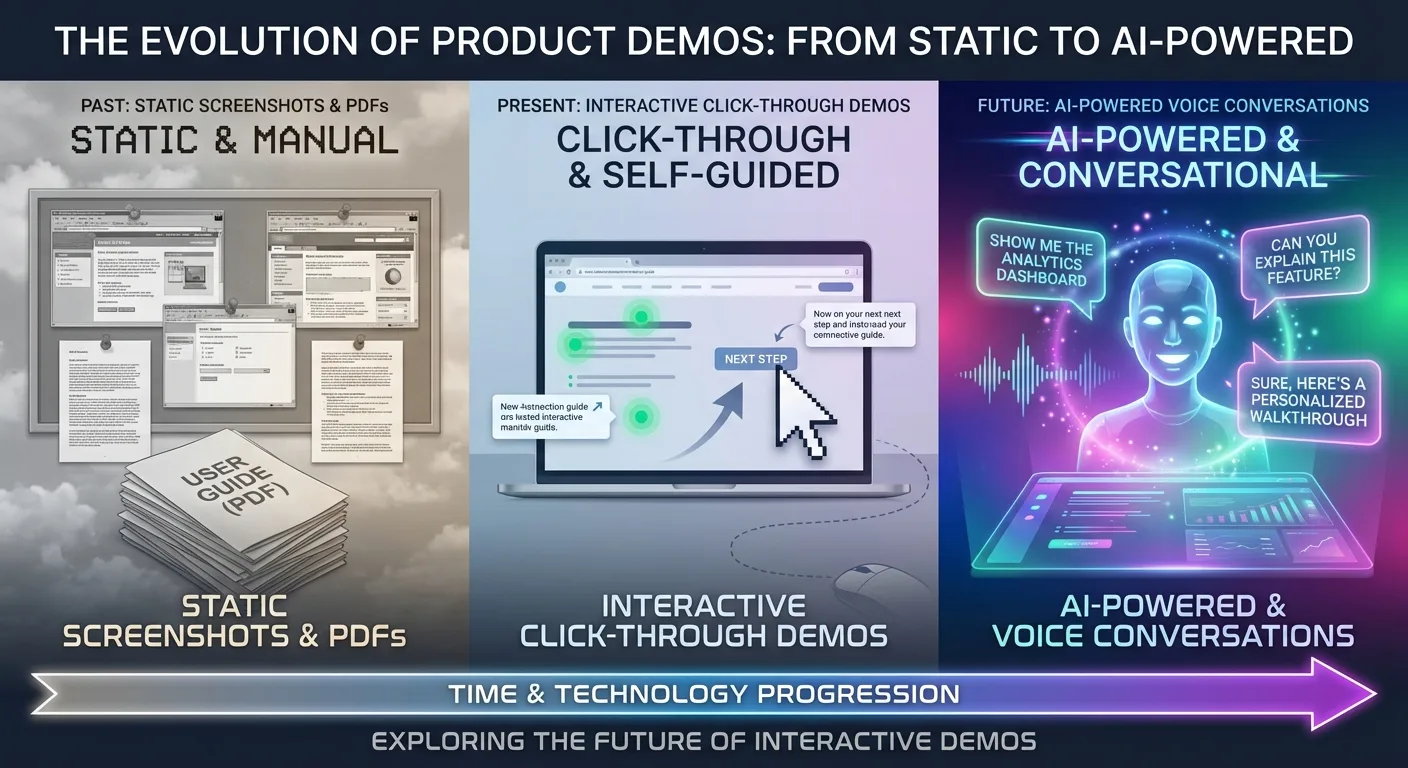
The way we demonstrate software has undergone a remarkable evolution. From printed manuals and static screenshots to video tutorials and sandbox environments, each generation of demo technology has brought us closer to the ideal: letting prospects experience products naturally, on their terms, with guidance that adapts to their needs. We are now entering the next era—AI-powered conversational demos—and it will change everything about how software is discovered, evaluated, and purchased.
A Brief History of Product Demos
The Screenshot Era (1990s-2000s)
Early software demos consisted of carefully curated screenshots with descriptive text. Marketing teams would capture the most flattering views of their products, often with dummy data designed to showcase features. Prospects evaluated software by looking at static images and imagining how they might use it.
The limitations were obvious: screenshots cannot convey workflow, interactivity, or the actual experience of using software. Yet for years, this was the standard approach.
The Video Era (2000s-2010s)
As bandwidth improved, video demos became feasible. Companies produced polished walkthroughs showing their products in action. Platforms like YouTube made distribution easy, and screen recording tools democratized production.
Videos were a significant improvement—prospects could see actual workflows and understand how features worked together. But videos are inherently one-directional. They cannot answer questions, adapt to viewer interests, or let prospects explore what matters to them. A prospect interested in reporting features must sit through sections on user management.
The Interactive Demo Era (2010s-2020s)
Companies like Navattic, Reprise, and Walnut pioneered interactive demo platforms. These tools let prospects click through products in guided or sandbox environments. Users could explore at their own pace, focusing on features relevant to their needs.
Interactive demos represented a major leap forward. Engagement rates soared compared to video. Prospects could self-qualify by exploring functionality. Sales teams received better intelligence about prospect interests.
But interactive demos still had limitations:
- Scripted paths: Most interactive demos follow predetermined flows
- No natural questions: Users cannot ask "How does this compare to Salesforce?" or "What about HIPAA compliance?"
- Generic experiences: The demo is the same for a technical evaluator and a business buyer
- Manual updates: Demo environments require ongoing maintenance as products evolve
The AI-Powered Demo Revolution
We are now entering a fundamentally new era. AI-powered demos combine the interactivity of sandbox environments with something entirely new: natural language conversation. This is not a marginal improvement—it is a category-defining shift.
What AI Demos Enable
Natural Language Interaction: Instead of clicking through menus, prospects simply ask questions. "Show me how billing works." "What integrations do you support?" "Can I customize the dashboard?" The AI understands intent and responds accordingly.
Adaptive Experiences: The AI tailors the demo to each user. A CFO asking about ROI metrics gets different content than a developer asking about APIs. The same AI handles both perfectly, creating personalized experiences at scale.
Real-Time Question Handling: Prospects can ask anything, anytime. The AI draws on product knowledge to answer questions about features, pricing, comparisons, security, and more—all within the context of the demo experience.
Live Product Exploration: Unlike scripted demos, AI-powered solutions like Demogod work with your actual product. The AI understands DOM structure, reads UI elements, and navigates naturally. No separate demo environment to maintain.
Voice: The Ultimate Interface
The most advanced AI demos incorporate voice interaction. Voice is the most natural human communication medium—we have been having conversations for millennia. Voice-controlled demos feel like having a knowledgeable colleague show you around the product.
Benefits of voice-powered demos:
- Hands-free exploration: Users can watch the screen while the AI navigates and explains
- Natural pacing: Conversation flows at human speed, not click speed
- Emotional engagement: Voice creates connection in ways text cannot
- Accessibility: Users who struggle with complex interfaces can participate fully
What the Future Looks Like
Proactive Intelligence
Future AI demos will not just respond—they will anticipate. By analyzing user behavior, the AI will identify confusion before users articulate it. "I notice you have been looking at the pricing page for a while. Would you like me to explain our plans and help identify which fits your needs?"
Cross-Platform Continuity
Demo conversations will persist across sessions and devices. A prospect who explores features on mobile can continue the conversation on desktop. The AI remembers context, previous questions, and expressed interests.
Multi-Modal Experiences
AI demos will seamlessly blend voice, text, visuals, and interactive elements. The AI might narrate while highlighting UI elements, display comparison tables while discussing competitors, or show video snippets of advanced features while explaining use cases.
Emotional Intelligence
Advanced AI will detect sentiment from voice tone, word choice, and behavior patterns. If a prospect sounds frustrated, the AI will adjust its approach. If they seem excited about a feature, the AI will explore related capabilities. The demo experience will feel genuinely human.
Deep Personalization
AI demos will integrate with CRM and marketing automation data to personalize experiences before the first interaction. A prospect from a healthcare company automatically gets HIPAA compliance information. An enterprise visitor sees SSO and admin features. Personalization happens at the individual level, not just the segment level.
Seamless Sales Handoff
When prospects are ready for human interaction, the AI will facilitate warm handoffs. Sales reps will receive comprehensive briefings: what the prospect explored, questions they asked, features they loved, concerns they raised. First sales conversations will feel like second meetings.
The Business Impact
Democratized Product Access
AI demos remove gatekeeping from the discovery process. Anyone can explore your product deeply, anytime, without scheduling constraints. This democratization benefits both vendors (more qualified leads) and buyers (better information before commitment).
Compressed Evaluation Cycles
When prospects can thoroughly explore products independently, evaluation timelines shrink. Technical due diligence happens before the first sales call. Security reviews begin with AI-answered questions. The entire procurement process accelerates.
Global Reach Without Global Teams
AI demos operate 24/7 in any language. A company with US-based sales can effectively serve prospects in Singapore, Germany, and Brazil without hiring local teams. The AI handles initial engagement; humans handle relationship building.
Insight-Driven Development
Every AI demo conversation generates insights. What features do prospects ask about most? What objections arise repeatedly? What competitive comparisons occur? This intelligence feeds directly into product roadmaps and marketing strategies.
Getting Ahead of the Curve
The transition to AI-powered demos is not a question of if, but when. Early adopters gain significant advantages:
First-mover differentiation: While competitors still use "request a demo" forms, AI-enabled companies offer instant, intelligent product exploration. The experience gap creates lasting impressions.
Learning curve advantages: AI demos improve with data. Companies that start now build richer training sets, better response patterns, and more refined experiences. Latecomers start from scratch.
Talent efficiency: As AI handles top-of-funnel engagement, sales teams focus on high-value activities. The resulting productivity gains compound over time.
Implementation Path
The path to AI-powered demos is more accessible than many assume:
- Start with existing products: Solutions like Demogod work with your current application. No separate demo environment required.
- Begin with specific use cases: Start with product tours, feature exploration, or FAQ handling. Expand from there.
- Integrate incrementally: AI demos can coexist with existing demo strategies. Add them as an option before making them primary.
- Measure and optimize: Track engagement, conversion, and lead quality. Use data to refine the experience.
The Inevitable Transformation
Every major shift in demo technology has followed the same pattern: early skepticism, gradual adoption, eventual ubiquity. Screenshots gave way to videos. Videos gave way to interactive demos. Interactive demos are giving way to AI-powered conversations.
The companies that thrive will be those that recognize this shift early and position themselves accordingly. The technology exists today. The business case is proven. The question is simply: will you lead this transformation or follow it?
The future of product demos is conversational, intelligent, and immediate. That future has already arrived.
Ready to experience the future of interactive demos? Try Demogod and see how AI-powered conversations are transforming product discovery.