
 DEMOGOD
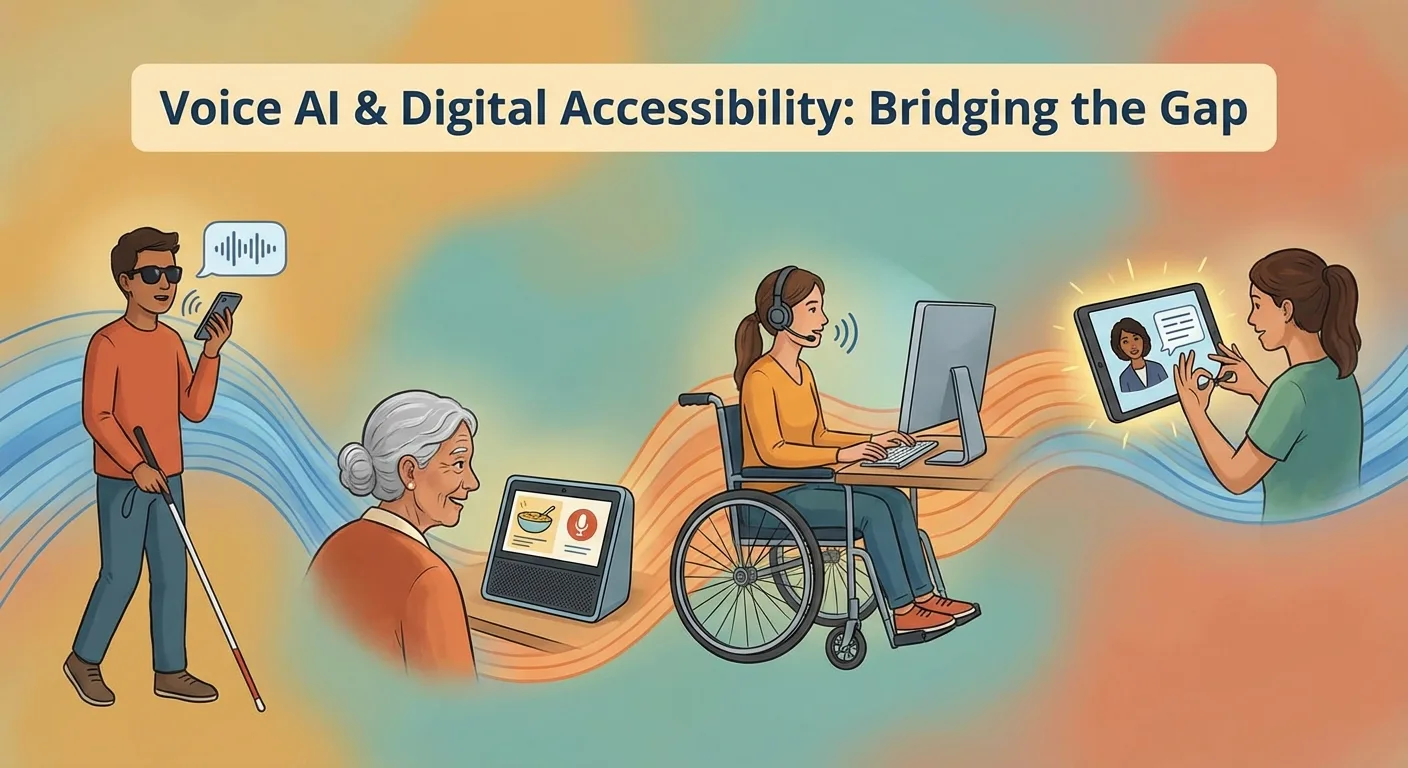
The promise of digital technology was universal access—information and services available to everyone, everywhere. The reality has fallen short. Complex interfaces, tiny buttons, dense text, and mouse-dependent navigation create barriers that exclude millions of users with disabilities. Voice AI is changing this equation, offering a natural interface that works for everyone regardless of physical or cognitive ability.
The Accessibility Crisis in Digital Experiences
The numbers are stark:
- 1.3 billion people worldwide live with some form of disability
- 2.2 billion people have vision impairment
- 466 million people have disabling hearing loss
- Over 15% of the global population experiences some form of disability
Yet the vast majority of websites and applications remain inaccessible. Studies consistently find that 95-98% of websites have accessibility failures. For users who rely on assistive technologies, the digital world is often frustrating, sometimes impossible to navigate.
Traditional accessibility approaches—screen readers, keyboard navigation, alt text—help but have limitations. They require users to adapt to interfaces designed for others. Voice AI flips this paradigm: the interface adapts to the user.
How Voice AI Transforms Accessibility
For Users with Visual Impairments
Screen readers convert text to speech, but they cannot convey visual layout, spatial relationships, or interface context. Users must build mental models of pages they cannot see.
Voice AI agents like Demogod go further:
- Contextual descriptions: "You are on the pricing page. There are three plan options displayed in columns."
- Guided navigation: "Would you like me to describe each plan, or would you prefer to hear about enterprise features?"
- Interactive exploration: Users ask questions and receive immediate, relevant responses
- Task completion: "I will help you complete the signup form. What email address would you like to use?"
Voice transforms passive screen reading into active conversation.
For Users with Motor Impairments
Mouse and keyboard interfaces assume fine motor control. For users with conditions like cerebral palsy, multiple sclerosis, or repetitive strain injuries, clicking small buttons or typing long forms is difficult or impossible.
Voice eliminates these barriers entirely:
- No clicking required: Navigation happens through speech
- No typing needed: Forms are completed through conversation
- No precision necessary: Voice commands work regardless of physical dexterity
- Reduced fatigue: Speaking is less physically demanding than typing for many users
For Users with Cognitive Disabilities
Complex interfaces overwhelm users with cognitive disabilities, learning differences, or attention disorders. Dense menus, multi-step processes, and technical jargon create cognitive load that impedes task completion.
Voice AI simplifies interactions:
- Natural language: Users communicate in their own words, not interface terminology
- Guided workflows: The agent breaks complex tasks into simple steps
- Patience and repetition: Users can ask the same question multiple ways without judgment
- Reduced memory load: No need to remember where features are located
For Users with Reading Disabilities
Dyslexia affects 10-15% of the population. Dense text, poor contrast, and complex layouts make reading challenging. Voice interfaces provide an alternative:
- Audio-first information: Content is spoken rather than read
- Conversational pacing: Information delivered at comfortable speeds
- Clarification on demand: Users can ask for explanations of confusing terms
For Elderly Users
Age-related changes affect vision, hearing, motor control, and cognitive processing. Many elderly users struggle with modern interfaces designed for young, tech-savvy audiences.
Voice is often the most accessible interface for older adults:
- Familiar interaction model: Conversation is natural; touchscreens are not
- Forgiveness: No penalty for mistakes or slow responses
- Adjustable pace: Conversations happen at the user pace
Enterprise Accessibility Compliance
Beyond moral imperatives, accessibility is increasingly a legal requirement:
ADA (Americans with Disabilities Act)
The ADA requires businesses to provide accessible services to people with disabilities. Courts have consistently ruled that this applies to websites and digital services. Non-compliance risks:
- Lawsuits and legal fees
- Settlements averaging $20,000-$50,000
- Reputation damage
- Lost customers
Section 508
Federal agencies and contractors must meet Section 508 accessibility standards. Voice interfaces can help organizations demonstrate compliance by providing alternative access paths.
WCAG (Web Content Accessibility Guidelines)
WCAG provides the technical standards for accessibility. Voice AI helps meet multiple WCAG requirements:
- Perceivable: Voice provides audio alternatives to visual content
- Operable: Voice navigation does not require keyboard or mouse
- Understandable: Conversational interfaces use natural language
- Robust: Voice works across devices and assistive technologies
European Accessibility Act
The EAA requires accessible products and services in the EU market. Organizations serving European customers must comply by 2025.
The Business Case for Accessible Voice AI
Market Size
The disability market represents enormous purchasing power:
- $490 billion in disposable income in the US alone
- $8 trillion globally when including friends and family
- The fastest-growing minority group as populations age
Companies that build accessible experiences capture customers competitors exclude.
Improved Experience for Everyone
Accessibility features benefit all users:
- Situational disabilities: A user with a broken arm, holding a baby, or driving benefits from voice
- Environmental factors: Bright sunlight, noisy environments, or hands-free contexts
- Preference: Many users simply prefer voice interaction regardless of ability
Designing for accessibility improves experiences universally.
Brand Differentiation
Accessible companies demonstrate values that resonate with customers:
- Commitment to inclusion
- Customer-centric design
- Social responsibility
In competitive markets, accessibility can be a meaningful differentiator.
Implementing Accessible Voice AI
Start with Voice-First Design
Rather than adding voice as an afterthought, design with voice as a primary interface:
- What tasks should users accomplish?
- What questions will they ask?
- How should the agent guide them?
Voice-first design naturally creates more accessible experiences.
Ensure Audio Quality
For voice to be accessible, audio must be clear:
- Natural voices: Robotic speech is harder to understand, especially for users with hearing impairments
- Appropriate pace: Adjustable speed accommodates different processing needs
- Clear pronunciation: Technical terms and proper nouns pronounced correctly
Provide Alternatives
Voice is not accessible for everyone—users who are deaf or have speech impairments need alternatives:
- Text transcripts of voice interactions
- Chat fallback options
- Visual indicators of audio content
True accessibility means multiple pathways to the same outcome.
Test with Real Users
Accessibility testing must include people with disabilities:
- Recruit users with various disabilities
- Observe real usage patterns
- Incorporate feedback into design
Automated testing catches technical issues but misses experiential problems.
Voice AI in Accessibility-Critical Applications
Healthcare
Healthcare interfaces must be accessible to patients with disabilities. Voice AI enables:
- Appointment scheduling without complex forms
- Medication information delivered audibly
- Patient portal navigation for users who cannot see screens
- Symptom reporting through conversation
Financial Services
Banking and financial services are essential; inaccessibility has severe consequences:
- Account management through voice
- Transaction history read aloud
- Bill payment without form completion
- Financial guidance through conversation
Government Services
Public services must be accessible to all citizens:
- Benefits applications via voice
- Information services without complex navigation
- Accessible kiosks for in-person services
- Civic participation enabled for all
E-commerce
Online shopping should not exclude users with disabilities:
- Product discovery through conversation
- Voice-guided checkout
- Order status and tracking audibly
- Customer service accessible to all
At Demogod, we build voice agents that make websites accessible through natural conversation—enabling users of all abilities to explore products, ask questions, and complete tasks without barriers.
The Future of Accessible Technology
Voice AI represents a fundamental shift in accessibility:
From adaptation to inclusion: Rather than retrofitting interfaces for accessibility, voice creates naturally inclusive experiences.
From compliance to opportunity: Accessibility becomes a competitive advantage rather than a checkbox.
From special cases to universal design: Voice benefits everyone, not just users with disabilities.
As voice technology matures, we are moving toward a world where disability no longer determines digital access. The interfaces that exclude will be replaced by conversations that include.
Getting Started
Organizations ready to improve accessibility through voice should:
- Audit current accessibility: Understand where barriers exist
- Identify high-impact use cases: Where would voice most improve accessibility?
- Implement incrementally: Start with key pathways, expand based on learning
- Measure outcomes: Track accessibility metrics and user feedback
Voice AI is not just a feature—it is a commitment to serving all users. That commitment is both the right thing to do and good business.
Ready to make your digital experience accessible to everyone? Experience Demogod and see how voice AI creates inclusive interfaces that work for all users.