
 DEMOGOD
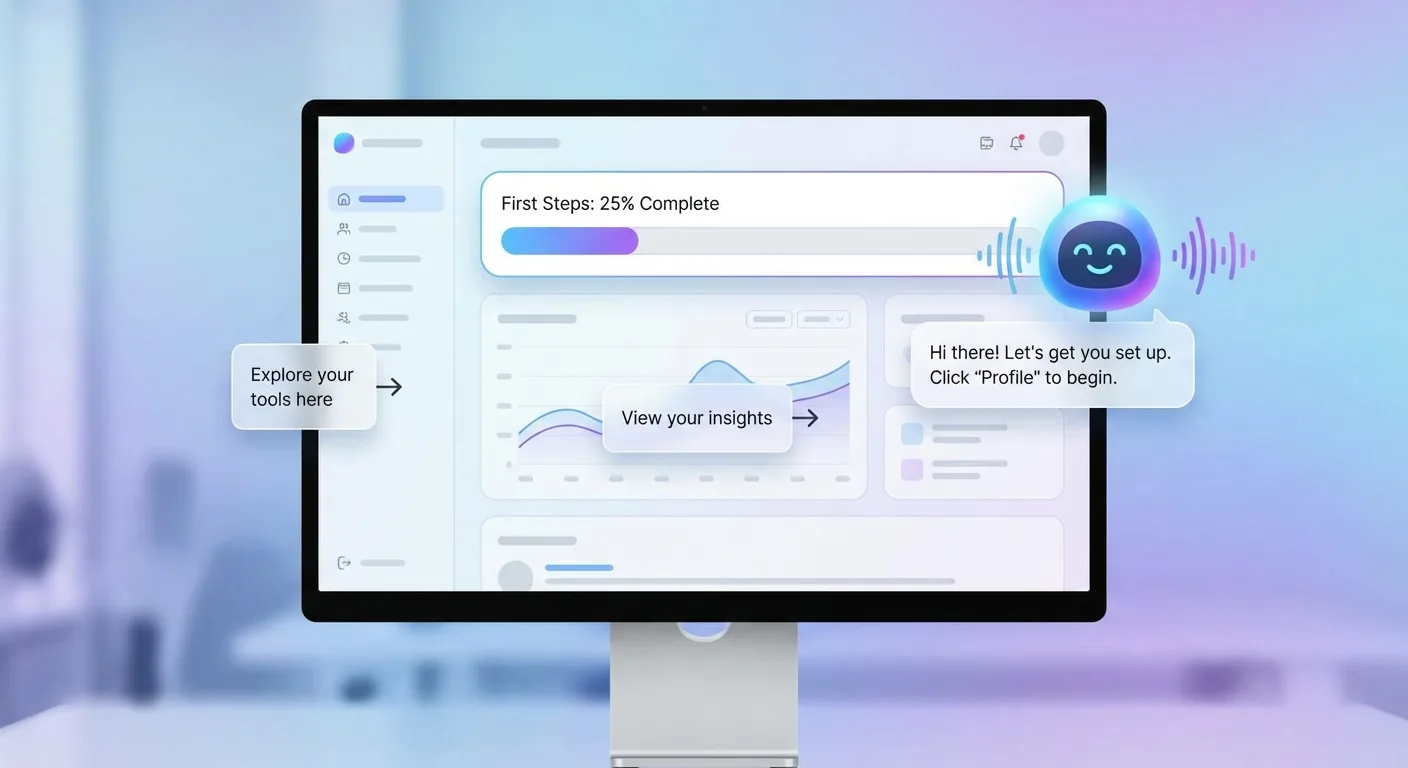
SaaS onboarding is where products succeed or fail. Users who understand your product in the first session convert. Those who struggle churn. Voice AI offers something previously impossible: personalized, interactive guidance for every trial user—without scaling your team.
At Demogod, we help SaaS companies deploy voice AI agents that guide users through product discovery. Here is how voice transforms onboarding and drives product-led growth.
The SaaS Onboarding Problem
Most SaaS products face the same challenge:
- High signup, low activation: Users sign up but never experience core value
- Time-to-value too long: Complex products require learning curves users abandon
- Support cannot scale: Personalized guidance costs too much per user
- Generic tours fail: One-size-fits-all walkthroughs miss individual needs
- Documentation goes unread: Users do not read help docs—they click around hoping to figure it out
The result: 40-60% of SaaS trial users never return after day one. They signed up with intent, but the product did not meet them where they were.
How Voice AI Changes Onboarding
Conversational Discovery
Instead of forcing users through predetermined paths, voice AI asks what they want to accomplish:
"Hi! I am here to help you get started. What brought you to [Product] today? Are you looking to [use case A], [use case B], or something else?"
The user responds naturally, and the voice agent adapts the onboarding flow to their specific goal. A marketer exploring analytics gets a different experience than a developer setting up integrations.
Just-in-Time Guidance
Voice AI provides help exactly when users need it—not through intrusive popups, but through available assistance:
"I notice you have been on the dashboard settings for a while. Would you like me to walk you through the customization options?"
Users who want help get it. Users who prefer exploring independently continue uninterrupted.
Hands-Free Learning
Voice lets users keep their hands on their work while learning. Instead of reading instructions, clicking away, then trying to remember what they read, users hear guidance while executing:
"Now click the blue button in the top right... perfect. This opens your project settings where you can invite team members."
Learning and doing happen simultaneously.
Voice Onboarding Patterns
The Welcome Agent
Greet new users immediately after signup:
- Introduce the product briefly
- Ask about their primary goal
- Offer to guide them to first value
- Provide escape hatch for self-directed users
Key metric: Activation rate for users who engage vs. skip
The Feature Guide
Help users discover and understand specific features:
- Triggered when user enters a feature area
- Explains what the feature does and why it matters
- Walks through common workflows
- Answers questions about edge cases
Key metric: Feature adoption rate
The Aha Moment Accelerator
Guide users to their first meaningful outcome:
- Identify what "aha" means for different user types
- Create fastest path to that moment
- Celebrate completion
- Suggest next steps
Key metric: Time to first value
The Rescue Agent
Intervene when users show signs of struggle:
- Detect confusion signals (repeated actions, long pauses, rage clicks)
- Offer proactive assistance
- Provide alternative approaches
- Escalate to human support when needed
Key metric: Churn prevention rate
Implementation Strategy
Phase 1: Critical Path Coverage
Start with the onboarding steps that matter most:
- Identify your product"s activation milestone
- Map the steps required to reach it
- Deploy voice guidance on those steps first
- Measure impact on activation rate
Phase 2: Expansion to Features
Once critical path works, expand:
- Add voice guidance to underutilized features
- Cover common support questions
- Build out use-case-specific flows
Phase 3: Personalization
Make voice onboarding smarter:
- Integrate with user data (role, company size, industry)
- Customize language and examples
- Remember previous interactions
- Adapt based on user behavior patterns
Voice AI vs. Traditional Onboarding
| Method | Pros | Cons |
|---|---|---|
| Product Tours | Easy to implement | Generic, often skipped, no interaction |
| Video Tutorials | Visual, reusable | Passive, cannot answer questions |
| Documentation | Comprehensive | Users do not read it |
| Live Support | Highly personalized | Expensive, does not scale |
| Chatbots | Scalable, 24/7 | Clunky, text-only, limited context |
| Voice AI | Personal, interactive, scalable | Requires audio capability |
Voice AI combines the personalization of live support with the scalability of automation.
Product-Led Growth Integration
Self-Serve with Support
PLG depends on users succeeding without sales involvement. Voice AI enables this by providing sales-quality guidance at scale:
- Answer product questions instantly
- Demonstrate value propositions conversationally
- Handle objections in real-time
- Guide toward upgrade triggers naturally
Qualification Through Conversation
Voice onboarding conversations reveal user intent and fit:
- What problems are they trying to solve?
- How sophisticated is their use case?
- Are they a decision-maker or evaluator?
- What is their timeline?
This data feeds your CRM and helps sales prioritize outreach to high-intent users.
Expansion Revenue
Voice AI helps existing users discover features they are not using:
"I noticed you have been using [basic feature] extensively. Did you know [advanced feature] can automate that workflow? Would you like me to show you?"
Feature discovery drives upgrade conversations naturally.
Measuring Voice Onboarding Success
Activation Metrics
- Activation rate: Users reaching your defined activation milestone
- Time to activation: How quickly users get there
- Voice-assisted vs. organic: Compare users who used voice guidance
Engagement Metrics
- Voice adoption rate: Percentage of users who interact with voice AI
- Questions asked: Engagement depth
- Sessions with voice: Repeat usage
Business Metrics
- Trial-to-paid conversion: The metric that matters most
- Support ticket deflection: Reduced support load
- NPS/CSAT: User satisfaction with onboarding experience
Common Objections Addressed
Users Will Not Use Voice
Some will not—and that is fine. Voice AI is additive. Users who prefer clicking around still can. But 30-50% of users will engage with voice when offered, and those users activate at higher rates.
It Is Expensive
Compare voice AI cost per conversation ($0.05-0.20) to:
- Support ticket cost: $5-15
- Sales call cost: $50-200
- Churned user lifetime value: $500-5000+
Voice AI pays for itself if it converts even a small percentage of users who would otherwise churn.
Our Product Is Too Complex
Complex products benefit most from voice guidance. Users struggling with complexity need the most help. Voice AI can break down complex workflows into conversational steps.
We Already Have Good Onboarding
Good onboarding can become great. Voice AI complements existing onboarding—it does not replace it. Users get the best of both: structured flows plus conversational support.
Getting Started
Start small and expand based on results:
- Identify your activation bottleneck: Where do users drop off?
- Deploy voice at that point: Test whether voice guidance improves progression
- Measure impact: Compare activation rates with and without voice
- Iterate: Improve the voice experience based on user feedback and analytics
- Expand: Add voice to more onboarding touchpoints
The Future of SaaS Onboarding
The SaaS companies winning at PLG will be those who deliver personalized experiences at scale. Voice AI makes this possible—every user gets guidance tailored to their needs, without requiring an army of support staff.
Try Demogod to see how voice AI transforms product onboarding. Speak to our demo agent, experience the difference, and imagine what voice guidance could do for your trial conversion rates.
Your trial users want to succeed with your product. Voice AI helps them get there.