
 DEMOGOD
The Chatbot Problem Nobody Talks About
Customer support chatbots have been "the future" for a decade. Yet 70% of customers still prefer human agents, and satisfaction scores for bot interactions hover around 35%.
The problem isn't the technology. It's the approach.
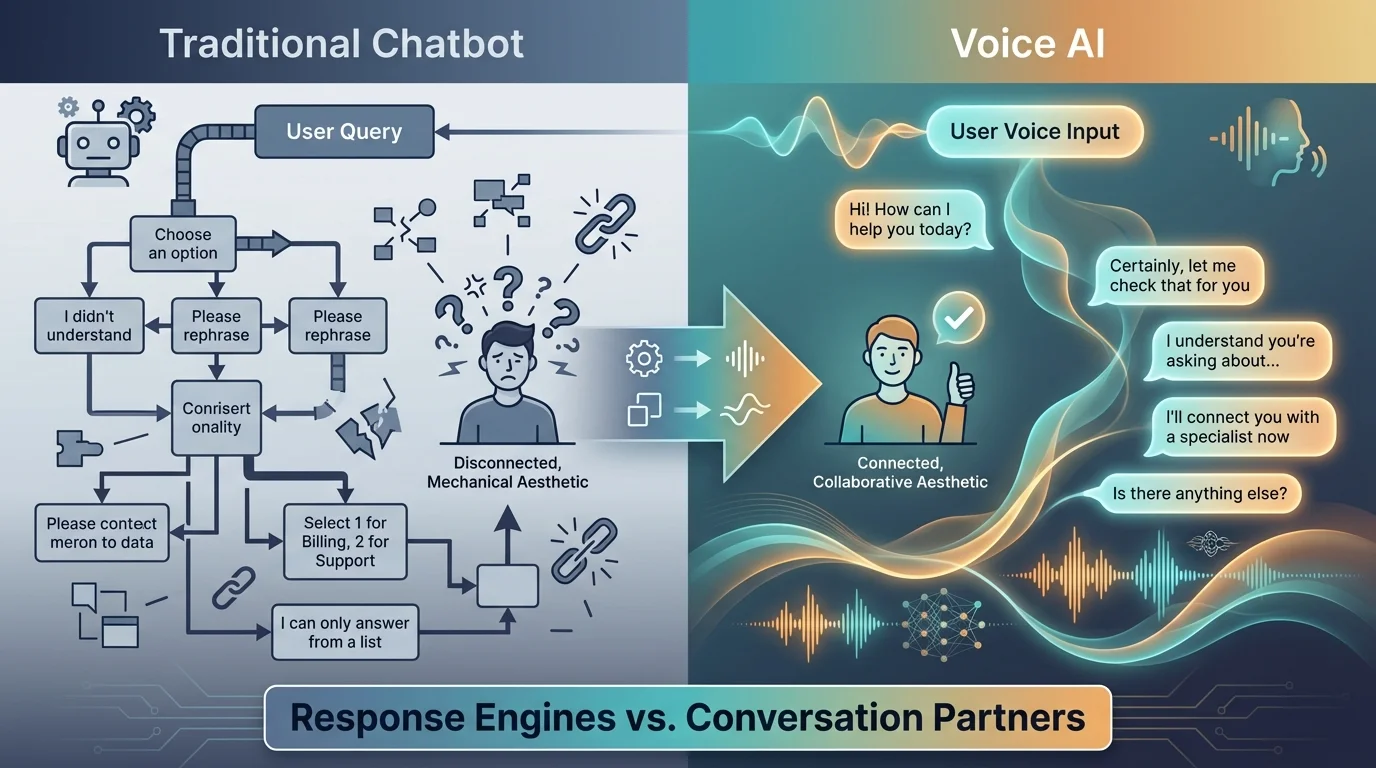
Traditional chatbots are response engines. Voice AI agents are conversation partners. That distinction changes everything.
Response Engines vs. Conversation Partners
Here's what separates them:
Traditional Chatbots (Response Engines):
- Pattern matching: "I see you mentioned 'password reset.' Here's our guide."
- Tree-based logic: Click option A → get response B → dead end
- No context retention: Every message is a new conversation
- Escalation as failure: "Let me transfer you to a human" = bot gives up
Result: Customers get frustrated, agents get overwhelmed, companies pay for both.
Voice AI Agents (Conversation Partners):
- Intent understanding: Recognizes what you're trying to achieve, not just keywords
- Dynamic adaptation: Changes approach based on user frustration, confusion, or success
- Continuous context: Remembers the conversation thread, previous interactions, account history
- Escalation as collaboration: "Let me handle this part, then connect you with Jane for the approval"
Result: Customers feel heard, agents focus on high-value work, companies reduce cost while improving satisfaction.
The Real Cost of "Good Enough" Chatbots
A 2024 Gartner study found that companies using traditional chatbots experienced:
- 42% of customers abandoning self-service and calling support anyway
- Average handle time (AHT) increased by 18% when agents had to fix bot mistakes
- Customer satisfaction (CSAT) dropped by 12 points when chatbots were the first touchpoint
The hidden cost: chatbots that fail generate more expensive work for human agents.
Voice AI changes this equation. When done right:
- 65% of issues resolved without human escalation (vs. 30% for chatbots)
- AHT decreased by 25% because agents receive better context from AI handoffs
- CSAT increased by 19 points when voice AI handled initial triage
The difference isn't automation. It's conversation quality.
What Voice AI Does Differently
1. Understands Ambiguity
Customer: "My thing isn't working."
Chatbot: "I don't understand. Please rephrase."
Voice AI: "Got it. Let me ask a few questions to narrow it down. Are you referring to a feature in your account, a billing issue, or something technical with our platform?"
Voice AI doesn't require precision from frustrated users. It navigates ambiguity.
2. Detects Emotion
Customer: "I've been trying to fix this for 30 minutes. This is ridiculous."
Chatbot: "I'm sorry to hear that. Here's a link to our FAQ."
Voice AI: "I can hear the frustration, and I'd feel the same way. Let me personally walk you through this right now—no more links, no more waiting."
Voice AI recognizes escalation signals (frustration, urgency, confusion) and adapts tone and approach in real-time.
3. Proactive Problem-Solving
Customer: "How do I export data?"
Chatbot: "Click Settings > Data > Export."
Voice AI: "I can guide you through the export now. By the way, I noticed your account has 50K records—exports over 10K can take 5-10 minutes. Want me to trigger it now and email you when it's ready, or would you prefer to do it during off-hours?"
Voice AI anticipates edge cases, account-specific limitations, and user preferences.
4. Seamless Handoffs
When escalation is needed, voice AI doesn't just transfer—it briefs the human agent.
Traditional handoff: "Customer transferred from bot. Issue: unknown."
Voice AI handoff: "Transferring Sarah to you. She's trying to upgrade her plan but hit a payment validation error. I've verified her identity, pulled her account history (3 years, no prior issues), and confirmed the card on file expired last month. She's ready to update payment—just needs the secure link."
The human agent starts the conversation informed, not confused.
Real-World Use Case: SaaS Customer Success
Imagine a SaaS company with 5,000 customers and a support team of 12.
Before Voice AI:
- 800 support tickets/week
- 400 "How do I...?" questions clogging the queue
- 6-hour average response time
- Agents spend 60% of time on repetitive questions
- Customer satisfaction: 72%
After Voice AI:
- 800 support requests/week (same volume)
- 520 resolved by voice AI (65%)
- 280 escalated to humans (but with full context)
- 45-minute average response time for escalated cases
- Agents spend 90% of time on complex, high-value issues
- Customer satisfaction: 91%
The math: Voice AI doesn't replace agents. It amplifies them.
Why Voice Matters (vs. Text Chatbots)
Voice AI adds three dimensions text can't match:
- Tone of voice: Detects frustration, confusion, urgency, satisfaction
- Speed of interaction: Natural conversation (150-200 words/min) vs. typing (40-60 wpm)
- Accessibility: Works for users who can't or won't type (mobile users, accessibility needs, multitaskers)
Voice isn't a "nice-to-have." It's a modality shift that changes how customers interact with support.
The "Responsibility Layer" for Support
This ties back to our broader thesis at Demogod: traditional tools connect users to answers. Voice AI takes responsibility for outcomes.
In customer support, that means:
- Chatbots connect users to FAQs and hope they figure it out
- Voice AI owns the resolution—either solving it directly or handing off with full context
You're not automating support. You're owning support outcomes.
What This Means for Support Teams
The shift from chatbots to voice AI isn't about replacing humans. It's about redefining roles:
Support Agents Become:
- Escalation specialists handling complex, high-impact cases
- Customer success partners focusing on proactive outreach, upsells, retention
- AI trainers refining voice AI responses based on real conversations
Voice AI Becomes:
- First responder handling 60-70% of inbound volume
- Context aggregator pulling account history, previous tickets, product usage patterns
- Triage specialist identifying urgency, emotion, account value before escalation
The result: customers get faster resolutions, agents get more meaningful work, companies reduce cost while improving satisfaction.
How to Implement Voice AI Support
If you're considering voice AI for customer support, here's where to start:
1. Identify High-Volume, Low-Complexity Queries
- Password resets
- "How do I...?" questions
- Billing inquiries
- Feature explanations
These are perfect for voice AI. They're repetitive, time-consuming, and don't require deep expertise.
2. Train on Real Conversations
Don't use generic datasets. Train your voice AI on:
- Your actual support tickets
- Your product documentation
- Your customer FAQs
- Your escalation patterns
The more domain-specific, the better the outcomes.
3. Design Handoff Protocols
Voice AI should know when to escalate:
- Customer explicitly asks for a human
- Issue requires account-level changes (permissions, billing overrides)
- Emotional escalation (frustration, anger, urgency)
- Complexity threshold exceeded (3+ back-and-forth exchanges without resolution)
4. Measure the Right Metrics
Don't just track "automation rate." Track:
- Resolution rate: % of issues fully resolved by voice AI
- Escalation quality: Do agents feel well-briefed when they receive handoffs?
- Customer satisfaction: Are CSAT scores higher for voice AI interactions?
- Agent productivity: Are agents spending more time on high-value work?
The goal isn't automation for automation's sake. It's better outcomes for everyone.
The Future of Support: Proactive, Not Reactive
Here's where this gets interesting: voice AI doesn't just respond to support requests. It can prevent them.
Imagine this:
Voice AI: "Hi Sarah, I noticed you've been trying to export data for the past 10 minutes. Need help?"
Customer: "Oh! Yes, I can't figure out how to filter by date range."
Voice AI: "Got it. Let me walk you through it. Click the calendar icon next to Export, then select your date range. Want me to wait while you do that?"
Customer: "Perfect, I see it now. Thanks!"
Ticket created: Zero.
Customer frustration: Avoided.
Support agent time: Saved.
This is proactive support—voice AI detects struggle patterns (page refreshes, repeated clicks, time-on-page) and offers help before frustration turns into a ticket.
Try It Yourself
The next time you encounter a customer support chatbot, ask yourself:
"Is this tool trying to connect me to an answer, or is it taking responsibility for my success?"
If it's the former, you've met a response engine.
If it's the latter, you've experienced what voice AI can do.
At Demogod, we build voice AI agents that don't just answer questions—they own outcomes. Whether it's onboarding, demos, or support, the principle is the same:
They connect. We take responsibility.
Want to see voice AI support in action? Try our live demo at demogod.me/demo. The AI agent will guide you through—and take ownership of your experience.